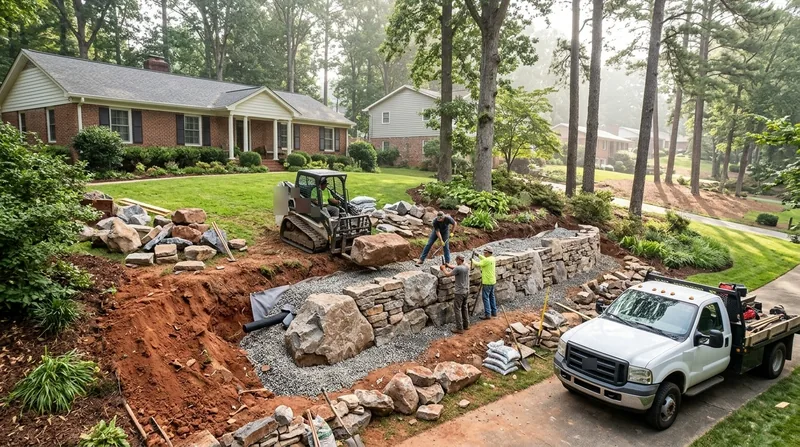




Boulder & Natural Stone Walls in Greensboro: Built for the Rolling Triad Terrain
When you need Boulder & Natural Stone Walls in Greensboro, you are working with some of the most demanding ground in the Triad. Our city sits on rolling uplands where dense red clay covers weathered granite and gneiss saprolite, and the land drops sharply into creek valleys like North and South Buffalo Creek and Horsepen Creek. Those slopes and the heavy clay are exactly why so many walls here lean, bulge, or wash out after a wet summer.
We build and repair boulder and natural stone walls that fit this landscape instead of fighting it. Machine-placed granite, fieldstone, and native rock set on a properly prepared base, with drainage that moves water away from the wall instead of through it. If your existing wall is already failing, start with our leaning and collapsed wall repair service before the next storm season.
Why Natural Stone Walls Matter on Greensboro's Clay and Slopes
Greensboro's red clay is the whole story. It soaks up summer thunderstorms and tropical-storm rain, gets heavy, and pushes hard against anything holding it back. Then winter freeze-thaw cracks the soil open and summer drought shrinks it again. A wall with no drainage and a shallow base will move under that cycle, and once it leans, it rarely stops on its own.
Boulder and natural stone walls handle this ground well when they are built right. The mass of the stone resists the clay's push, and the gaps between rocks let us install proper drainage. The neighborhoods show the pattern clearly:
- Irving Park and Sunset Hills have 1920s Tudor and Colonial Revival homes with old fieldstone and brick garden walls that are now settling and separating.
- Lindley Park and Westerwood bungalows sit on short steep front yards where a low stone wall is the only practical way to hold the grade.
- Summerfield and Jamestown subdivisions from the 1980s and 1990s are lined with rotting landscape timber and railroad tie walls that need replacement with stone.
- Newer cut-and-fill neighborhoods rely on tall walls, and those are the ones most exposed to drainage failures.
In every case, the fix starts with water and base preparation, not with stacking more rock on top.
Key info: A stone wall along Horsepen Creek that held fine for years can fail after one tropical-storm soaking if the clay behind it has nowhere to drain. We see this most in Sunset Hills and along the reservoir edges near Lake Brandt and Lake Higgins.
For the official rules on walls, setbacks, and when engineered drawings are required, check the City of Greensboro's building permit information at greensboro-nc.gov before you plan a tall or tiered wall.
How We Build Boulder and Natural Stone Walls in Greensboro
We do not just drop rock on the slope. Every wall starts with an excavation to stable subgrade, a compacted crushed-stone base, and a drainage plan that accounts for the clay. Then we place the stone with equipment, set the batter, and backfill in lifts so the wall locks together. The same sequence applies whether we are repairing a leaning wall or building new.
- We walk the site and check the slope, soil, and water paths before we quote anything.
- We excavate to stable soil and compact a crushed-stone base that will not settle.
- We install drainage stone, filter fabric, and outlet pipes so water leaves the wall.
- We machine-place granite and fieldstone, setting each course with the proper batter and tie-in.
- We backfill in compacted lifts and finish the top with capstone or planted soil.
That process is why our stone walls stay put through Greensboro's wet summers and freeze-thaw winters.
Key info: On a recent job in Summerfield, a homeowner had a railroad tie wall that had rotted and pushed forward about eight inches. We removed the ties, rebuilt the base, and set native fieldstone with a gravel drainage core. The wall now holds the grade and matches the wooded lot. See our Summerfield service page for more local examples.
Boulder and Natural Stone Wall Methods We Use
The right method depends on height, load, and how the wall needs to look. Here is how we match the approach to the site.
| Approach | Description | Best for |
|---|---|---|
| Dry-laid fieldstone | Stone stacked without mortar, relying on gravity, batter, and tight fit. | Low garden walls under 3 feet on gently sloped lots. |
| Mortared natural stone | Stone set in mortar over a concrete footing for a solid, finished face. | Visible walls along driveways and front yards where a clean look matters. |
| Machine-placed granite boulders | Large boulders set with an excavator and pinned for stability. | Taller walls and steep creek-valley slopes that need mass. |
| Stone veneer over block | A structural block core faced with natural stone. | Tall walls that need engineering and a natural finish. |
| Repair and re-face | Rebuild the base and drainage, then reset or replace the stone face. | Leaning walls that are still structurally sound. |
We pick the method that fits your grade, your budget, and the look you want, and we tell you plainly when a repair is not enough.
Boulder & Natural Stone Walls Cost in Greensboro: What to Expect
Most boulder and natural stone walls in Greensboro start around $25 per square foot, and that figure is a starting point, not a final number. The real cost depends on wall height, how much excavation the slope needs, and how far the stone has to be moved. Access is a big one: a backyard wall behind a narrow gate in Lindley Park costs more to build than the same wall with a clear driveway approach.
Drainage work, removal of an old failed wall, and any engineering required for a tall or tiered wall all add to the total. That is why we quote after we see the site, and why we encourage you to get two or three estimates on the same scope. Compare what each one includes for base prep and drainage, not just the price per square foot. Our full pricing overview breaks down the ranges in more detail.
Hiring a Retaining Wall Contractor Near Me in Greensboro: What to Check
Stone walls are heavy work, and the contractor you pick matters more than the rock. A fully insured contractor protects you if something goes wrong on the site. Ask for proof of both, and ask whether the crew doing the work is the same crew named in the contract.
Get at least two or three written estimates and check references on similar walls, not just any outdoor project. Ask who pulls the permit, because walls above roughly 4 feet from the footing, or walls that support a driveway or structure, often need one and may need engineered drawings. Setback and property-line rules apply too, so confirm the local building department's requirements before work starts. If you are in an HOA, get the architectural approval in writing first. When you are ready, contact us for a free estimate and we will walk the site with you.
Boulder & Natural Stone Walls in Greensboro: Pricing Guide
| Service | Price | Details |
|---|---|---|
| Dry-laid fieldstone wall | Starting at $25/sq ft | Includes base prep, drainage stone, and fieldstone placement for low garden walls |
| Mortared natural stone wall | Starting at $45/sq ft | Includes concrete footing, mortar set, and capstone for visible front-yard walls |
| Machine-placed granite boulder wall | Starting at $55/sq ft | Includes excavator placement and pinning for taller, load-bearing walls |
| Stone veneer over block core | Starting at $65/sq ft | Includes structural block, natural stone facing, and drainage for tall walls |
| Complex or large-scale job | On estimate | Tiered walls, steep slopes, and engineered designs need an on-site look first |
| Estimate | Free | Response within 24h at (336) 203-7877, no obligation to book |
Indicative pricing, the exact cost depends on square footage, finish, and site access. Free personalized estimate within 24h at (336) 203-7877.


