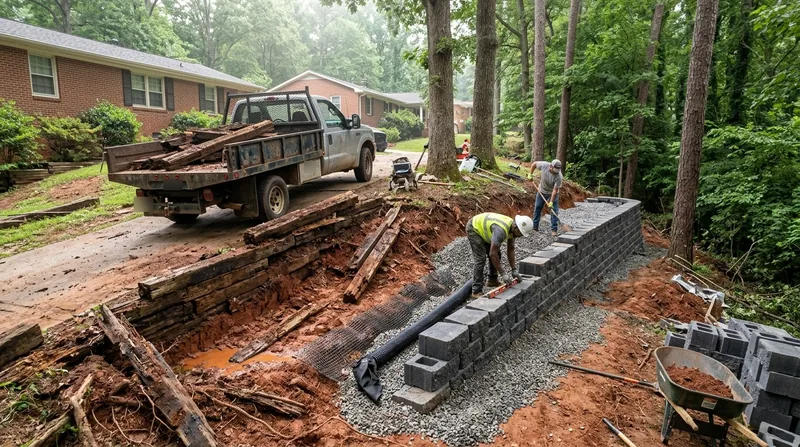




Greensboro's rolling uplands sit on dense red clay over weathered granite and gneiss saprolite, cut by creek valleys like North and South Buffalo Creek and Horsepen Creek. That clay is the reason so many 1980s and 1990s subdivision walls toward Summerfield and Jamestown are failing right now. Railroad Tie Wall Replacement in Greensboro means pulling out creosote-soaked ties that have been rotting for thirty years and rebuilding the wall with drainage that actually works. We handle the demolition, the haul-away, the gravel backfill, and the rebuild in segmental block, concrete, or natural stone. If your wall is still standing but leaning, start with leaning and collapsed wall repair before the whole thing comes down.
Why Railroad Tie Walls Fail in Greensboro's Red Clay
Creosote-treated ties were sold as a cheap answer to grade changes, and for fifteen years they worked. Then the clay does what clay does here. Summer storms and tropical-storm rain soak the soil, the ties trap the water because nobody installed drainage, and winter freeze-thaw pushes the wall forward an inch a year. Drought shrinks the clay and opens gaps behind the ties, so the next rain drives them out of line. By the time a homeowner in Starmount or along Horsepen Creek notices, the wall is leaning and the ties are hollow.
- Creosote breaks down in the tie and the wood checks, splits, and rots from the inside out.
- Clay soil holds water against the ties because the original wall has no gravel backfill or drain pipe.
- Freeze-thaw cycles push saturated ties out of plumb and open the joints between courses.
- Old ties are heavy, chemically treated, and cannot go in the regular trash, so haul-away matters.
Replacing the wall without fixing the drainage just resets the clock on the same failure.
Key info: A tie wall in a 1990s Summerfield subdivision that leans after a wet spring is usually holding back saturated clay, not failing block. We check the soil and drainage before we quote the rebuild.
Permits for walls above roughly 4 feet from the footing, or walls that support a driveway or structure, go through the local building department and thresholds vary, so verify before you dig. The City of Greensboro publishes its permit and development rules at greensboro-nc.gov.
How We Tear Out and Rebuild a Tie Wall in Greensboro
We start by looking at what the wall is holding back and where the water goes. A tie wall on a short steep front yard in Lindley Park is a different job than a long tiered wall behind a ranch in Starmount. We mark utilities, protect the lawn and driveway, and cut the wall in sections so the slope above never sits unsupported overnight. Demolition is the dirty part, and we keep it contained.
- We cut and pull the old ties, load them out, and haul the creosote-treated wood to a permitted disposal site.
- We excavate behind the wall and remove the saturated clay that caused the failure.
- We install a compacted gravel footing and set the first course dead level.
- We place drain pipe at the base, wrap it in filter fabric, and backfill with washed gravel.
- We build the new wall in segmental block, poured concrete, or natural stone to the engineered height.
- We compact the backfill in lifts and restore the grade, seed, and cleanup.
Every rebuild gets a drainage layer, because that is the part the old wall never had.
Key info: On a Jamestown job last spring, the ties had rotted through and the clay behind them was running out with every rain. We rebuilt in segmental block with a gravel chimney drain, and the wall has not moved since.
If the wall is on a slope that keeps sloughing above the top, see our slope stabilization and erosion control work before the new wall goes in.
Rebuild Options: What Replaces the Ties
Once the old wall is out, you have real choices. The right one depends on height, load above the wall, budget, and how the finished wall should look against the house. We quote each option with the drainage included, not as an add-on.
| Approach | Description | Best for |
|---|---|---|
| Segmental block | Interlocking concrete units with gravel backfill and drain pipe. | Most residential replacements, including walls above 4 feet. |
| Poured concrete | Formed and reinforced wall with a waterproofed back face. | Tall walls holding a surcharge or a driveway. |
| Natural stone or boulder | Fieldstone or boulder wall set with proper batter and drainage. | Irving Park and Sunset Hills lots where stone matches the house. |
| New timber wall | Modern pressure-treated timber with gravel and drain pipe. | Low garden walls under 3 feet on a tight budget. |
We tell you when a cheaper option will fail again in ten years and when it will not.
Railroad Tie Wall Replacement Cost in Greensboro: What to Expect
Most tie wall replacements here start around From $35/sq ft for a standard segmental block rebuild with drainage. That figure covers demolition, haul-away, footing, gravel, drain pipe, block, and cleanup. A short wall in Westerwood may land near the low end, while a tall tiered wall in Summerfield with limited access runs higher.
- Wall height and square footage drive the price more than anything else.
- Access matters: a wall behind a fence or on a steep bank slows demolition and hauling.
- Creosote tie disposal adds cost because the old wood needs a permitted landfill.
- Engineered drawings, if the building department requires them, add a design line item.
- Material choice moves the number, with poured concrete and natural stone above standard block.
Get two or three written estimates and compare what each one includes for drainage, because that is where cheap bids cut corners. Our full pricing overview breaks down the ranges by wall type.
Hiring a Retaining Wall Contractor Near Me in Greensboro
Ask for the license and insurance certificate before anyone touches the wall, and call the references on jobs that are at least two years old. Walk the property line with the contractor so the setback and the neighbor's grade are clear. If the wall is over 4 feet or holds a driveway, confirm who pulls the permit and who is responsible for the engineered drawings. HOA rules in the newer subdivisions toward Summerfield and Oak Ridge can dictate wall color and height, so check before you order block.
Reach us through our contact and free estimate page or call (336) 203-7877.
Railroad Tie Wall Replacement in Greensboro: Pricing Guide
| Service | Price | Details |
|---|---|---|
| Standard tie wall replacement | Starting at $35/sq ft | Includes demolition, creosote tie haul-away, gravel footing, drain pipe, and segmental block rebuild. |
| Tall or tiered wall | Starting at $48/sq ft | Includes engineered layout and heavier block; height above 4 feet and surcharge loads move the price. |
| Natural stone or boulder rebuild | Starting at $55/sq ft | Includes stone selection and setting; matching existing fieldstone on Irving Park lots adds labor. |
| Complex or large-scale job | On estimate | Steep access, engineered drawings, or multiple tiers need an on-site look before we quote. |
| Travel | Included | In Greensboro and surrounding areas, no separate call-out or mileage fee. |
| Estimate | Free | Response within 24h at (336) 203-7877, no obligation to book. |
Indicative pricing, the exact cost depends on square footage, finish, and site access. Free personalized estimate within 24h at (336) 203-7877.


