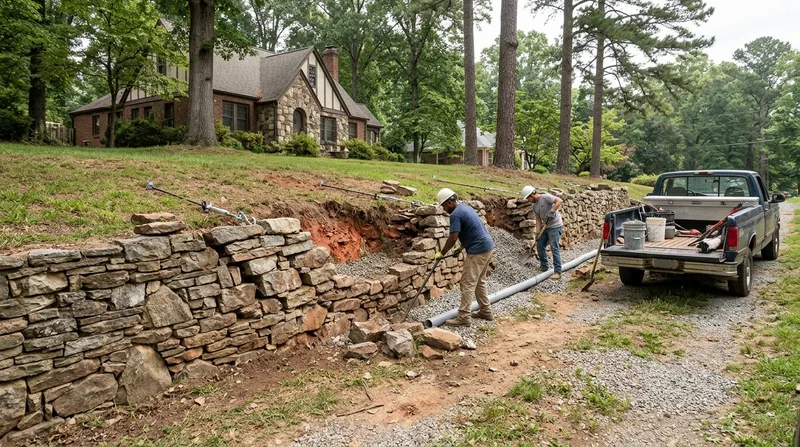




Leaning & Collapsed Wall Repair in Greensboro: When the Clay Pushes Back
If your wall is tilting, bulging, or already down, you need Leaning & Collapsed Wall Repair in Greensboro before the next storm finishes the job. Greensboro sits on rolling Triad uplands where dense red clay blankets weathered granite and gneiss saprolite, and that clay behaves like a sponge. Creek valleys along North Buffalo, South Buffalo, and Horsepen Creek funnel runoff, and neighborhoods around Lake Brandt and Lake Higgins see water stack up fast.
Older blocks tell the story: the Victorian and Queen Anne homes in Fisher Park, the 1920s Tudor and Colonial Revival houses in Irving Park and Sunset Hills with their old fieldstone and brick garden walls, and the bungalows in Lindley Park and Westerwood sitting on short steep front yards. Postwar ranches in Starmount and the east side, 1980s and 1990s subdivisions out toward Summerfield and Jamestown full of rotting railroad tie walls, and newer cut-and-fill neighborhoods with tall segmental block walls all fail the same way when drainage is missing.
We respond fast to leaning, bulging, and collapsed walls, stabilize with tieback anchors where the wall can be saved, correct the drainage that caused the pressure, and rebuild what is past saving. Call (336) 203-7877 or start with our retaining wall repair page to see how we triage a failing wall.
Why Greensboro Clay Wrecks Retaining Walls
The dominant failure mode here is hydrostatic pressure in saturated red clay. Summer thunderstorms and tropical-storm remnants soak the backfill, water finds no relief because the wall was built without proper drainage, and the wall starts to lean or bulge. Then winter freeze-thaw cycles and summer drought shrink and swell the clay, opening cracks and loosening the block courses. Walls on slopes above the creeks and reservoirs in Greensboro take the worst of it.
- Walls built without a gravel drainage envelope or weep holes trap water until the wall tips.
- Railroad tie and timber walls in 1980s and 1990s subdivisions rot at the soil line and collapse without warning.
- Old fieldstone and brick garden walls in Irving Park and Sunset Hills crack when roots and clay movement shift the footing.
- Tall segmental block walls in newer cut-and-fill neighborhoods lean when the geogrid and compaction were done short.
- Downspouts and gutter failures dump roof water directly behind walls, and that is often the whole cause.
Any of these signs means the wall is telling you it is overloaded, and waiting usually turns a repair into a full replacement.
Key info: A homeowner in Sunset Hills called us about a brick garden wall leaning eight inches toward the driveway after a July storm. The downspout had been discharging behind it for years. We relieved the pressure, reset the footing, and corrected the drainage instead of tearing the wall out.
For the official word on when a wall needs a permit in Greensboro, check the City of Greensboro building permit information at greensboro-nc.gov, and confirm the threshold with the building department before any rebuild.
How We Repair a Failing Wall in Greensboro
Every leaning or collapsed wall gets the same first step: find out why it moved. We dig out the failure, read the soil and drainage, and decide whether stabilization or a rebuild is the honest answer. On walls that can be saved, we anchor and drain. On walls that are past it, we rebuild with the right block, drainage, and compaction from the footing up.
- We inspect the wall, footing, and backfill and locate the water source.
- We relieve the pressure by correcting drainage and adding weep paths.
- We stabilize leaning walls with tieback anchors driven into stable soil.
- We rebuild collapsed sections with proper base, geogrid, and gravel backfill.
- We restore the surface and confirm the wall sheds water away from the house.
When the wall is too far gone, we move to retaining wall replacement and build it right the first time.
Key info: A collapsed railroad tie wall in a Summerfield subdivision was holding a driveway on a cut-and-fill lot. We pulled the rotted ties, rebuilt with segmental block, and tied the new wall into the slope with geogrid so the driveway stopped sagging.
Repair Approaches We Use
The right approach depends on how far the wall has moved and what is pushing it. Here is how we match the method to the failure.
| Approach | Description | Best for |
|---|---|---|
| Tieback anchoring | Anchors driven into stable soil pull a leaning wall back to plumb. | Leaning walls that are otherwise sound |
| Drainage correction | Gravel backfill, weep holes, and surface grading relieve hydrostatic pressure. | Bulging walls and saturated clay backfill |
| Partial rebuild | We replace the failed section and re-key it into the standing wall. | Collapsed sections on long walls |
| Full rebuild | New footing, base, geogrid, and drainage from the ground up. | Walls past saving or rotted timber |
| Temporary shoring | We brace the wall to protect the house until the permanent fix. | Emergency calls and active collapse |
We choose the least invasive method that actually solves the pressure problem, not the fastest one.
Leaning & Collapsed Wall Repair Cost in Greensboro: What to Expect
Most leaning and collapsed wall repairs in Greensboro start around From $2,500, and the final number depends on how much wall has moved, how deep the footing sits, and how much drainage work is needed. A small brick garden wall that needs anchoring and a downspout fix sits near the bottom of that range. A tall segmental block wall on a slope above Horsepen Creek with a collapsed section and no drainage can run several times higher.
Access matters as much as size. Walls behind a house in Lindley Park with a narrow side yard take more labor than a wall open to a driveway in Summerfield. Proximity to structures, tree roots, and the permit threshold all move the price. That is why we recommend two or three estimates on any wall repair, so you can compare scope, not just the number.
See our pricing page for the full breakdown before you call.
Hiring a Retaining Wall Contractor Near Me in Greensboro
When a wall is leaning over a driveway or a child's play area, the contractor you pick matters more than the price. Ask for proof of license and insurance, get everything in writing, and make sure the scope explains how the wall will drain after the repair. A repair that ignores drainage will fail again in the next wet season.
Check references on similar walls, confirm who pulls the permit if the wall is above the local threshold, and ask how they handle HOA rules if you live in a subdivision. If a contractor cannot explain why the wall moved, keep looking.
Reach out through our contact page and we will walk the wall with you and give you a straight answer.
Leaning & Collapsed Wall Repair in Greensboro: Pricing Guide
| Service | Price | Details |
|---|---|---|
| Leaning wall stabilization with tieback anchors | Starting at $2,500 | Includes anchor installation and drainage correction on a sound wall; access and wall height move the price. |
| Partial collapsed section rebuild | Starting at $3,800 | Replaces the failed section and re-keys it into the standing wall; footing depth and block type affect cost. |
| Full wall rebuild with new drainage | Starting at $6,500 | New footing, base, geogrid, and gravel backfill; wall length and slope height drive the number. |
| Emergency shoring and stabilization | On estimate | Needs an on-site look because active collapse and proximity to structures change the scope. |
| Travel | Included | in Greensboro and surrounding areas, no separate call-out or mileage fee |
| Estimate | Free | Response within 24h at (336) 203-7877, no obligation to book |
Indicative pricing, the exact cost depends on square footage, finish, and site access. Free personalized estimate within 24h at (336) 203-7877.


