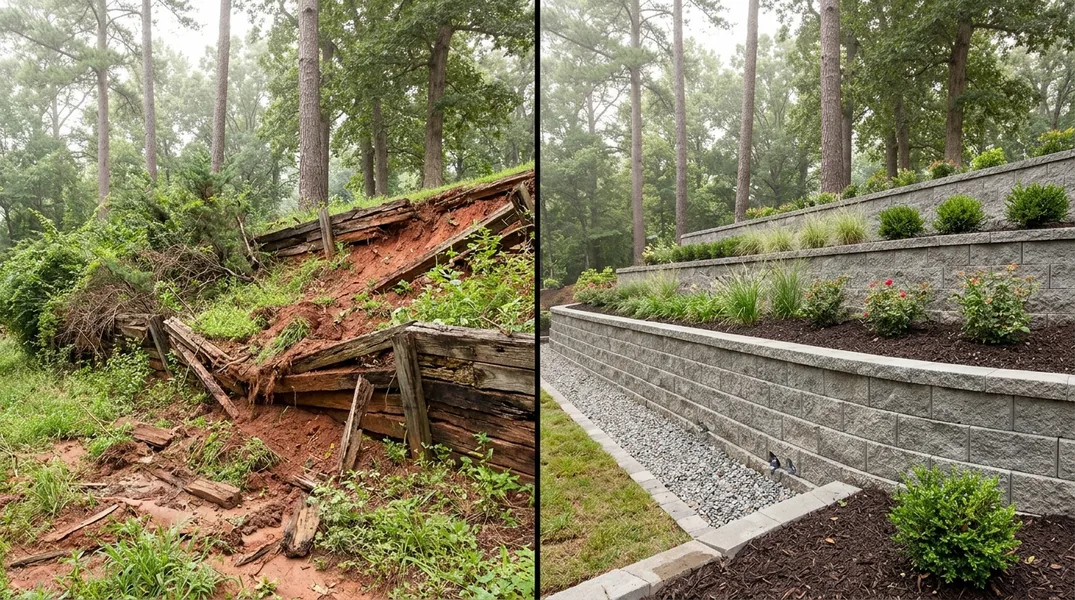
Why Triad Clay Soil and Rolling Lots Change the Material Conversation
If you live in Greensboro, you already know that the ground here is not like the sandy coastal plain or the rocky mountains. The Piedmont's red clay is dense, it holds water, and it expands and contracts with the seasons. On top of that, many Greensboro lots are not flat. They roll, they slope toward the street or a creek, and they often need some kind of grade change to make a backyard usable. That combination of heavy clay and changing elevation is exactly why the material you choose for a retaining wall matters more here than it might in other parts of the country.
A wall that looks fine on paper can fail quickly when it is holding back saturated clay. Water pressure builds behind the wall, and if the material and drainage system are not matched to the soil, you get bulging, leaning, or outright collapse. This is why local knowledge matters. A contractor who works in the Triad every week understands how clay behaves after a wet spring and how to design a wall that manages water instead of fighting it. Whether you are comparing a concrete retaining wall to a boulder wall or trying to decide between block and segmental systems, the soil should be the first thing you think about, not the last.
Concrete Retaining Walls: Strength for Heavy Clay and Tight Spaces
Concrete Retaining Walls are a strong choice when you need serious structural capacity in a limited footprint. Poured concrete can be designed to resist the lateral pressure that saturated clay puts on a wall, and it can be reinforced and anchored to handle taller grades. On a rolling lot where you want to maximize usable flat space, a concrete wall often takes up less room than a boulder wall while still holding the soil back. It is also a good option when the wall needs to support something above it, like a patio, a driveway, or a structure.
The tradeoff is that concrete walls are less forgiving during installation. They require proper forming, reinforcement, and a well-engineered drainage system, because a solid concrete face will not flex the way a segmental wall can. For homeowners who want a clean, modern look and long-term durability, though, concrete is hard to beat. If you are weighing this option against others, it helps to talk through your specific slope and soil conditions before you commit. You can request a free estimate and get a straight answer about whether concrete fits your site.
Block Retaining Walls and Segmental Retaining Walls: Flexibility That Handles Movement
Block retaining walls, often called segmental retaining walls, are built from interlocking units that stack without mortar. This design gives the wall a small amount of flexibility, which is a real advantage in clay soil that moves with moisture. Instead of cracking like a rigid wall might, a segmental system can shift slightly and keep its integrity. These walls are also highly customizable: you can choose from many colors, textures, and block sizes, and you can build curves and terraces that follow the natural shape of a rolling Greensboro lot.
Segmental retaining walls rely on proper base preparation, compaction, and drainage to perform well. The blocks themselves are only part of the system. Behind the wall, you need gravel, filter fabric, and a way for water to escape so that pressure does not build up. When installed correctly, a block retaining wall can last for decades and look great doing it. Many homeowners in High Point and across the Triad choose segmental walls because they offer a good balance of cost, appearance, and performance on sloped ground. If you are planning a Retaining Wall Installation, ask your contractor how the block system will be drained and reinforced for your specific soil.
Boulder Retaining Walls: Natural Look for Slopes and Landscape Beds
Boulder retaining walls use large, natural stones to hold back soil, and they are especially popular on properties where homeowners want a rustic, organic look. On a rolling lot with existing trees and landscaping, a boulder wall can blend into the surroundings in a way that concrete or manufactured block cannot. Boulder walls are also good at handling uneven terrain, because the stones can be placed to follow the contours of the slope rather than forcing a perfectly straight line.
That said, boulder walls are not right for every situation. They generally work best for shorter walls and gentler grades, and they require careful placement so that each stone sits securely. In heavy clay, drainage behind the boulders is just as important as it is with any other material. A boulder wall that is built without proper backfill and water management can settle or shift. For homeowners in Winston-Salem and Greensboro who want a natural aesthetic and have a moderate slope, boulders can be an excellent fit, but they should be evaluated by someone who understands how they perform in Piedmont soil.
Retaining Wall Installation Near Me: Matching the Material to Your Lot
There is no single best material for every retaining wall in Greensboro. The right choice depends on the height of the wall, the steepness of the slope, the soil conditions, how much space you have, and what you want the finished wall to look like. A tall wall holding back saturated clay near a foundation has different requirements than a two-foot garden wall at the edge of a patio. A professional assessment should look at all of these factors before recommending concrete, block, boulder, or a segmental system.
It also helps to think about the long term. A wall is a significant investment, and the material you choose affects maintenance, lifespan, and resale appeal. If an existing wall is failing, you may be deciding between Retaining Wall Repair and a full Retaining Wall Replacement, and the same material questions apply. Homeowners in Burlington and throughout the region face the same clay and slope challenges, so local experience is worth a lot. If you want to understand pricing for different materials, the best first step is a conversation about your site. Call Greensboro Retaining Wall at (336) 203-7877 or reach out online to schedule a free estimate and get clear, practical guidance for your property.
Looking for a professional retaining wall contractor in Greensboro? Greensboro Retaining Wall responds fast for all your retaining wall needs.
Get a Free QuoteOur services: Retaining Wall Installation · Retaining Wall Repair · Retaining Wall Replacement