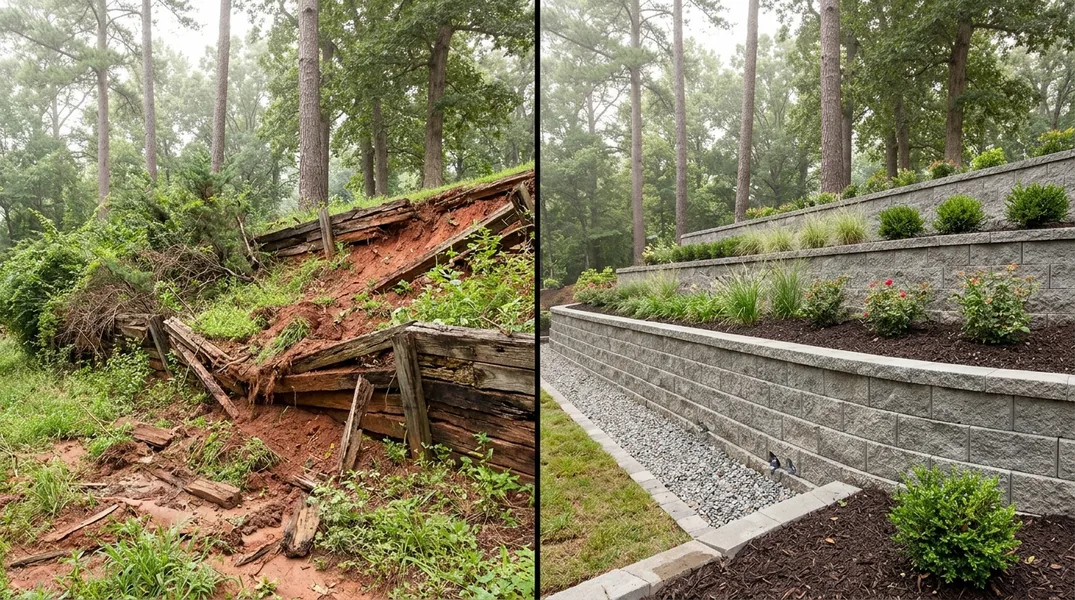
Why Greensboro's Red Clay Is Tough on Retaining Walls
If you live in Greensboro, you already know that the soil under your lawn is not ordinary dirt. The region is famous for its dense red clay, a heavy, sticky soil that expands when wet and shrinks when dry. That cycle of swelling and contracting puts constant pressure on anything built into the ground, and retaining walls are no exception. A wall that looks fine in a dry summer can be quietly pushed out of alignment by the time the spring rains arrive.
The problem is not just the clay itself but how water moves through it. Red clay drains slowly, so after a heavy storm the soil behind a wall can become saturated and incredibly heavy. That trapped water creates hydrostatic pressure, which is the single most common reason walls lean, bow, or crack. Homeowners in High Point and Winston-Salem deal with the same soil conditions, which is why proper drainage design matters as much as the wall itself. If your wall was built without adequate drainage, it may already be under stress even if you cannot see it yet.
The Most Common Reasons Retaining Walls Fail Here
Most failing walls in the area share a few root causes. The first is poor drainage: no weep holes, no gravel backfill, or a clogged drain that lets water pile up behind the wall. The second is an inadequate base. Red clay shifts with moisture, and a footing that was not dug deep enough or compacted properly will move over time. The third is underestimating the load. A wall holding back saturated clay needs to be engineered for far more force than a wall holding back sandy soil, and many older walls were simply not built for it.
Another frequent culprit is missing or failing geogrid reinforcement. Geogrid is the mesh that ties the wall blocks back into the soil, and without it a tall wall is essentially a stack of heavy blocks waiting to tip. Tree roots, gutter downspouts that dump water right behind the wall, and even driveways or patios added uphill can all add load the original builder never planned for. When several of these issues combine, a Retaining Wall Repair project becomes urgent rather than optional. The good news is that a professional assessment can usually identify which cause is at work before the wall completely gives way.
Warning Signs of a Leaning or Failing Retaining Wall
A leaning retaining wall is the most visible warning sign, but it is rarely the first one. Start by looking at the top course of blocks: if it no longer runs straight and level, the wall is moving. Next, check for bowing, where the middle of the wall pushes outward in a curve. Bowing often means the soil behind the wall is exerting uneven pressure, and a bowing retaining wall fix usually involves relieving that pressure and reinforcing the structure, not just patching the face. Cracks that run vertically or in a stair-step pattern through the blocks are another red flag, especially if they are wider than a hairline.
Other signs are easy to miss. Soil settling or a depression appearing behind the wall, weeds growing through joints, blocks that feel loose when you press on them, and water seeping out at the base long after a storm all point to drainage or structural problems. Sometimes the first clue is on the downhill side, where the wall bulges or the ground cracks. If you notice any of these, avoid parking heavy equipment or piling snow and debris near the wall, and keep an eye on how quickly the movement progresses. A wall that shifts a little each season is a failing retaining wall that needs attention.
Retaining Wall Repair Near Me: When to Call a Professional
Small cosmetic issues can sometimes wait, but structural movement should not. As a rule of thumb, call a professional when the wall leans more than a couple of inches, when bowing is visible from the street, when cracks are widening, or when the wall holds up a driveway, patio, or slope that could damage your home if it gave way. Waiting rarely makes the problem cheaper. Water finds the weakest point and makes it weaker, and a wall that could have been stabilized may end up needing full Retaining Wall Replacement instead.
A qualified contractor will examine the wall's height, the soil behind it, the drainage system, and the condition of the base before recommending a fix. Sometimes the solution is targeted repair, such as restoring drainage and re-anchoring the upper courses. In other cases, especially with tall walls or severe bowing, rebuilding with proper reinforcement and Concrete Retaining Walls or engineered block is the safer long-term choice. If you are searching for retaining wall repair near me and want an honest assessment, Greensboro Retaining Wall can inspect your wall and explain your options. Reach out for a free estimate or call (336) 203-7877 to schedule a visit.
How to Prevent Future Failures on Red Clay
Prevention starts with drainage. A well-built wall on red clay includes a gravel drainage layer, filter fabric to keep clay from clogging the gravel, and weep holes or a perforated pipe that carries water away from the wall. Gutters and downspouts should discharge well past the wall, not behind it. During construction, the base must be dug into stable soil and compacted in lifts, and tall walls should include geogrid layers engineered for the load. These details are what separate a wall that lasts decades from one that starts leaning within a few years.
Once your wall is in place, a little maintenance goes a long way. Keep vegetation trimmed back, watch for new cracks or settlement after heavy rain, and make sure drainage outlets stay clear. If you are planning a new wall rather than repairing an old one, choosing the right design from the start is the best protection. Professional Retaining Wall Installation accounts for soil type, slope, and water flow, which is exactly what red clay demands. Homeowners in Burlington and across the region face the same conditions, so it pays to work with a local team that understands the ground. For questions about pricing or to plan a new wall, contact Greensboro Retaining Wall at (336) 203-7877.
Looking for a professional retaining wall contractor in Greensboro? Greensboro Retaining Wall responds fast for all your retaining wall needs.
Get a Free QuoteOur services: Retaining Wall Installation · Retaining Wall Repair · Retaining Wall Replacement